📧 sales@hnfbattery.com 💬 WhatsApp: +86 134-8090-2696
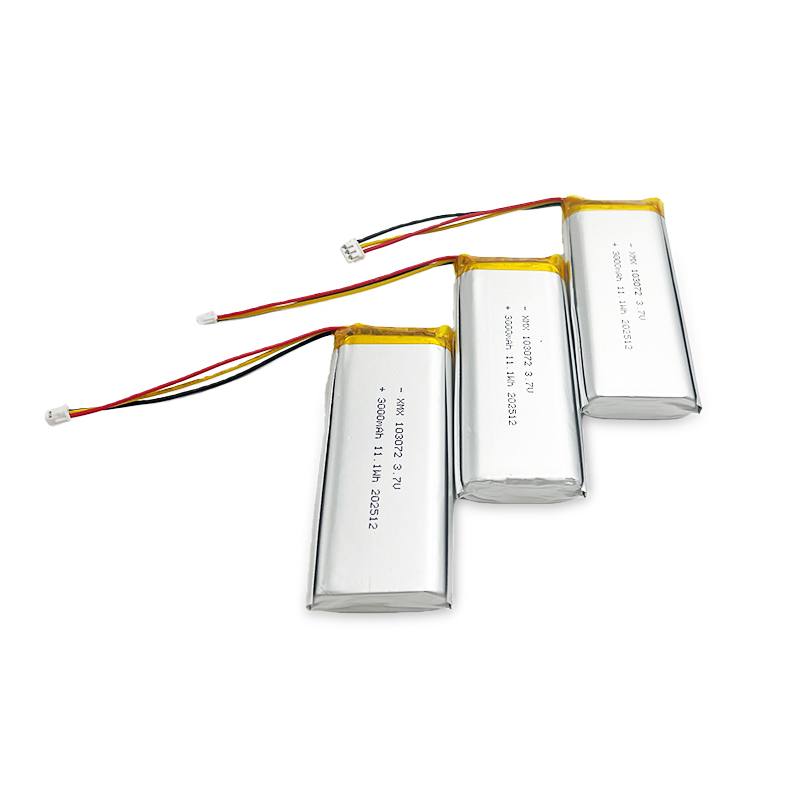
Lithium polymer (LiPo) batteries are a type of rechargeable lithium-ion battery that uses a solid or gel-like polymer electrolyte instead of the liquid electrolyte found in standard cylindrical lithium-ion cells. This fundamental difference in construction allows LiPo cells to be manufactured in ultra-thin, flat pouch formats that conform to the internal space of the device they power, rather than requiring the device to be designed around a fixed cylindrical cell size.
Since their commercial introduction in the late 1990s, LiPo batteries have become the dominant power source for smartphones, tablets, drones, wearables, and a wide range of portable consumer and industrial electronics. Their combination of high energy density, flexible form factor, and lightweight construction makes them the preferred choice wherever space and weight are at a premium.
Like all lithium-ion chemistries, a LiPo battery stores and releases energy through the movement of lithium ions between a cathode and an anode during charge and discharge cycles. What distinguishes the LiPo design is the polymer separator and electrolyte system, which immobilizes the electrolyte within a solid or semi-solid matrix rather than allowing it to flow freely as a liquid.
During charging, an external power source drives lithium ions from the cathode material — typically lithium cobalt oxide or lithium manganese oxide — through the polymer electrolyte to the graphite anode, where they are stored as intercalated lithium. During discharge, the ions travel back through the electrolyte to the cathode, releasing electrons through the external circuit to power the connected device. The polymer electrolyte acts as both the ionic conductor and the physical separator between the two electrodes, eliminating the need for a rigid cylindrical steel or aluminum can.
The terms LiPo and Li-ion are often used interchangeably in product listings, which creates confusion for buyers. The key distinctions are:
Electrolyte type: Standard Li-ion cells use a liquid electrolyte contained within a rigid metal can. LiPo cells use a polymer gel electrolyte contained within a flexible foil pouch.
Form factor: Li-ion cells are almost exclusively produced in cylindrical (18650, 21700) or prismatic hard-case formats. LiPo cells are produced as flat, flexible pouches in virtually any custom dimensions.
Energy density: Both chemistries offer similar gravimetric energy density at the cell level, typically 150 to 250Wh/kg depending on cathode chemistry and cell design. LiPo cells can achieve slightly higher volumetric energy density in thin form factors because the pouch packaging wastes less space than a rigid cylindrical can.
Safety profile: Li-ion cylindrical cells are inherently more mechanically robust due to their rigid housing. LiPo cells are more susceptible to physical puncture and require careful handling, but modern BMS protection largely mitigates the risk of thermal events in normal use.
Applications: Li-ion cylindrical cells dominate applications where standardized cell sizes are practical, such as e-bike batteries, power tools, and energy storage systems. LiPo cells dominate applications where custom dimensions and thin profiles are required, such as smartphones, drones, and wearables.
Flexible form factor: LiPo cells can be manufactured to virtually any flat dimensions, from a few millimeters thick to several centimeters, and from a few millimeters wide to tens of centimeters. This allows product designers to specify a battery that fits the available space rather than designing the product around a standard cell size.
Lightweight construction: The aluminum foil pouch casing is significantly lighter than the steel or aluminum can used for cylindrical Li-ion cells, contributing to lower overall product weight. This advantage is particularly significant in weight-sensitive applications such as drones, RC aircraft, and wearable devices.
High discharge rates: LiPo cells designed for high-rate applications, particularly in the RC and drone market, can deliver sustained discharge rates of 20C to 100C or higher, enabling the high instantaneous current draw required by brushless motors and power electronics.
Low profile: The flat pouch construction allows LiPo cells to be as thin as 2 to 3mm, enabling ultra-slim product designs that are physically impossible with cylindrical cells.
Scalable capacity: Because LiPo cells are manufactured to custom dimensions, capacity can be precisely specified for the application rather than being limited to the fixed capacity steps available in standard cylindrical cell sizes.
LiPo batteries are used across an exceptionally broad range of industries and product categories. Understanding where LiPo cells are most commonly applied helps buyers identify whether this chemistry is the right fit for their product or procurement requirement.
Consumer electronics: Smartphones, tablets, laptops, e-readers, smartwatches, wireless earbuds, and portable speakers all rely on LiPo cells for their combination of thin profile and high energy density.
Drones and UAVs: Consumer camera drones, commercial inspection UAVs, and racing drones use high-rate LiPo packs for their ability to deliver high instantaneous current to brushless motors while minimizing weight.
IoT and wearable devices: GPS trackers, health monitoring wearables, smart home sensors, and industrial IoT modules use small-format LiPo cells in the 100mAh to 2000mAh range that fit within miniaturized device enclosures.
Medical devices: Portable patient monitors, infusion pumps, hearing aids, and implantable device charging systems use medical-grade LiPo cells for their thin profile and reliable capacity delivery.
RC hobby: RC cars, boats, aircraft, and helicopters use multi-cell LiPo packs in configurations from 1S to 6S for high-discharge-rate power delivery.
Industrial and field equipment: Handheld scanners, portable test instruments, field communication devices, and military electronics use ruggedized LiPo cells for their weight advantage over cylindrical alternatives.
When sourcing LiPo batteries, buyers encounter a standard set of specifications that define the cell’s electrical characteristics and physical dimensions. Understanding these parameters is essential for selecting the correct cell for a given application.
Model number (e.g. 103048): The model number encodes the physical dimensions of the cell. The first two digits represent thickness in millimeters, the next two represent width in millimeters, and the last two represent length in millimeters. A 103048 cell is therefore 10mm thick, 30mm wide, and 48mm long.
Nominal voltage: Single-cell LiPo batteries have a nominal voltage of 3.7V, a full-charge voltage of 4.2V, and a minimum discharge voltage of 3.0V. Multi-cell packs multiply these values by the number of series cells.
Capacity (mAh): Capacity indicates how much charge the cell can store, measured in milliampere-hours. A 1500mAh cell can theoretically deliver 1500mA for one hour, or 750mA for two hours, before reaching the minimum discharge voltage.
Energy (Wh): Energy is calculated as voltage multiplied by capacity and represents the total work the cell can perform. A 3.7V 1500mAh cell stores 5.55Wh.
Discharge rate (C rating): The C rating expresses the maximum safe continuous discharge current as a multiple of capacity. A 1500mAh cell rated at 1C can safely deliver 1500mA continuously. A cell rated at 5C can deliver 7500mA. Most consumer LiPo cells are rated at 1C to 2C; high-rate drone and RC cells are rated at 20C to 100C.
Connector type: LiPo cells are typically supplied with JST, PH2.0, ZH1.5, MX1.25, XT30, or bare wire terminations depending on the application.
LiPo batteries require more careful handling than alkaline or NiMH batteries. Understanding the key safety principles protects both the user and the product.
Never overcharge: Charging a LiPo cell above 4.2V per cell causes rapid electrolyte decomposition and significantly increases the risk of thermal runaway. Always use a charger with automatic CC/CV termination and a BMS-equipped pack.
Never over-discharge: Discharging below 3.0V per cell causes irreversible anode damage and capacity loss. Repeated over-discharge leads to internal short circuits. Always use a BMS with low-voltage cutoff.
Avoid physical damage: Puncturing or crushing a LiPo cell can cause an internal short circuit and thermal runaway. Store and transport cells in protective cases and avoid subjecting them to sharp impacts.
Store at partial charge: For long-term storage, keep LiPo cells at approximately 3.8V per cell, which corresponds to roughly 50% state of charge. This minimizes both capacity fade and the risk of self-discharge to damaging low voltages.
Use certified cells: Always source LiPo batteries from suppliers who can provide UN38.3 test reports and MSDS documentation, confirming that the cells have passed international safety testing for transport and handling.
For B2B buyers, distributors, and product manufacturers sourcing LiPo batteries at volume, the following criteria are essential for evaluating suppliers:
Verify that the supplier can provide UN38.3 test reports for the specific cell models you are ordering, not just generic documentation. Request capacity test data from a representative sample of the production batch rather than relying solely on specification sheets. Confirm that the supplier performs internal resistance matching and capacity grading before shipment, particularly for applications requiring consistent cell performance. Evaluate the supplier’s minimum order quantity, lead time, and willingness to supply samples for engineering validation. Assess the supplier’s technical support capability, including whether they can assist with custom dimension specification, BMS selection, and connector configuration for your specific application.
HNF Battery is a factory-direct LiPo battery manufacturer based in Dongguan, China, supplying custom and standard LiPo cells from 100mAh to 20,000mAh to B2B customers across Europe, North America, and Asia. Contact us at sales@hnfbattery.com or WhatsApp +86 134-8090-2696 to discuss your sourcing requirements.
Request a custom quote, or reach our team on your preferred platform.