📧 sales@hnfbattery.com 💬 WhatsApp: +86 134-8090-2696
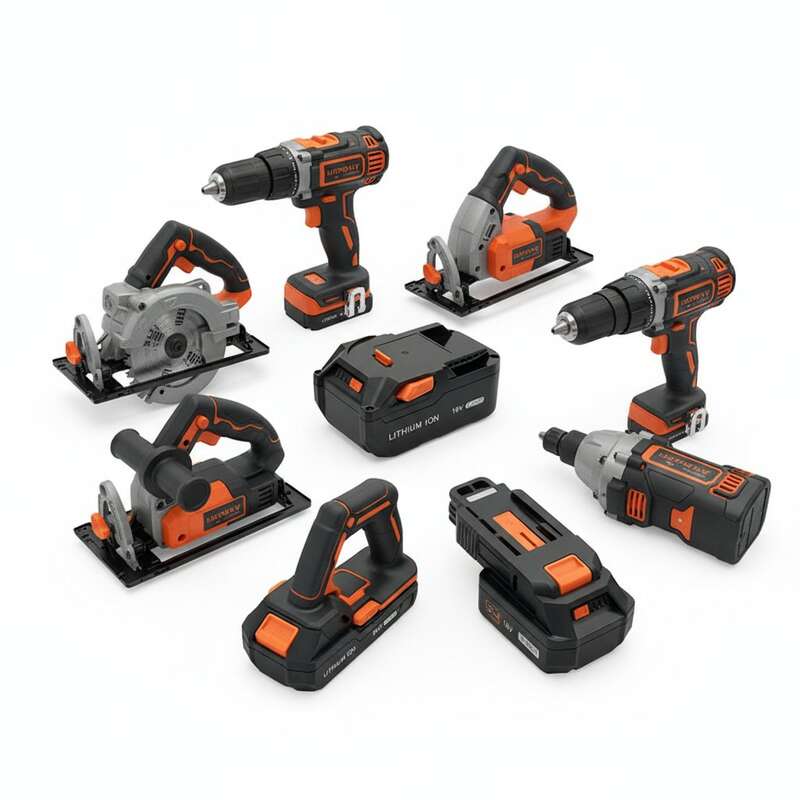
The global cordless power tool market has undergone a fundamental transformation over the past decade. Where corded tools once dominated professional trades and heavy construction, cordless platforms powered by lithium-ion battery packs now account for the majority of new tool sales across virtually every category, from compact drills and impact drivers to circular saws, angle grinders, and outdoor power equipment.
This shift has created a large and growing aftermarket for replacement and compatible power tool batteries. Professional tradespeople, construction contractors, facilities maintenance teams, and DIY enthusiasts all rely on battery-powered tools as primary work equipment, and when the original battery pack degrades after two to four years of regular use, the user faces a choice: pay the OEM price for a branded replacement, which often costs 40% to 60% of the price of a new tool kit, or source a compatible replacement battery at a fraction of the cost.
For battery distributors, tool importers, and OEM tool manufacturers, this dynamic creates significant commercial opportunity. Understanding the technical requirements of power tool battery packs, the key specifications that determine performance and compatibility, and the sourcing criteria that separate reliable replacement packs from low-quality alternatives is essential for building a profitable and sustainable position in this market.
Modern cordless power tool systems are built around platform architecture, where a single battery pack design is compatible with an entire range of tools from the same manufacturer. A user who owns a 18V drill, an 18V circular saw, and an 18V impact driver from the same brand can use a single battery across all three tools, simplifying inventory and reducing the total number of batteries needed for a working day.
The platform architecture is defined by three elements: the nominal voltage of the battery, the mechanical interface between the battery and the tool body, and the communication protocol between the battery’s BMS and the tool’s motor controller.
Voltage determines which tools the battery can power. Common platform voltages include 12V for compact tools, 18V and 20V for mainstream professional tools, 36V and 40V for high-power outdoor equipment such as lawn mowers and chainsaws, and 54V and 60V for the most demanding demolition and heavy construction applications.
Mechanical interface is the physical sliding or rotating mount that connects the battery to the tool. Each manufacturer uses a proprietary interface design, which is one of the primary mechanisms by which OEM brands prevent cross-brand compatibility. The rail profile, locking latch geometry, and terminal positioning are all brand-specific and cannot be interchanged between platforms without physical modification.
Communication protocol adds a digital layer on top of the basic power terminals. Most major tool brands transmit battery state-of-charge data, cell temperature, and pack identification signals through additional signal pins in the connector, allowing the tool to display remaining runtime, protect against over-discharge, and in some systems, verify that the battery is an authorized OEM unit. Compatible replacement batteries must replicate this communication behavior correctly to function fully with the host tool platform.
When evaluating a replacement or OEM power tool battery, the following specifications determine whether the pack will meet the performance expectations of professional users.
Nominal voltage and cell configuration: An 18V pack uses 5 cells in series at 3.6V nominal per cell. A 20V MAX pack (used by DeWalt and Black+Decker) uses the same 5S configuration but is marketed at the maximum charge voltage of 4.0V per cell rather than the nominal. A 36V pack uses 10 cells in series. Understanding the cell count and configuration is essential for verifying that the BMS protection thresholds are set correctly for the specific platform.
Capacity: Measured in ampere-hours (Ah), capacity determines how long the tool can run between charges. Common capacity options for 18V platforms range from 2.0Ah for compact lightweight packs, through 4.0Ah and 5.0Ah for standard professional use, to 9.0Ah and 12.0Ah for extended-runtime packs used in high-drain applications. A higher-capacity replacement pack is generally compatible with the same tool and charger as the original lower-capacity pack, and users typically welcome the extended runtime.
Discharge rate: Power tools place significantly higher current demands on batteries than most consumer electronics. A circular saw cutting hardwood may draw 30A to 50A at full load. An angle grinder under load may draw 20A to 35A continuously. The cells used in power tool packs must be rated for sustained high-current discharge without excessive voltage sag or temperature rise. Cells suitable for consumer electronics but not rated for high discharge rates will overheat, lose voltage under load, and degrade rapidly in power tool applications.
Internal resistance: Low cell internal resistance is critical for power tool performance. A pack with high internal resistance loses a larger proportion of its stored energy as heat during high-current discharge, resulting in reduced power output, voltage sag that causes the tool motor to lose speed under load, and accelerated cell degradation. Grade-A cells from reputable manufacturers have internal resistance values well below 30mΩ per cell for 18650 format, while lower-grade cells may measure 50mΩ or above.
Cycle life: Professional power tool users charge their batteries once or twice daily during working weeks. A battery that delivers 300 cycles before capacity falls below 80% will last approximately 18 months under professional use conditions. A battery rated for 600 cycles at the same capacity retention threshold will last approximately three years, representing a significantly better value proposition for tradespeople who depend on their tools for income.
The replacement power tool battery market is structured around compatibility with major OEM platform interfaces. Understanding which platforms have the largest installed base and the highest replacement demand helps distributors prioritize their product range.
18V / 20V MAX platforms represent the largest segment of the global professional cordless tool market. This voltage class is used across the mainstream product ranges of all major tool brands and has the deepest aftermarket replacement demand. Users in this segment include both professionals who use tools daily and homeowners who use them occasionally, creating demand across a wide range of capacity and price points.
12V compact platforms address a smaller but dedicated segment of users who prioritize compact tool size and weight for overhead work, tight spaces, and light-duty applications. The 12V replacement market is smaller than 18V in absolute volume but benefits from high brand loyalty and consistent repeat purchasing.
40V and above platforms serve the outdoor power equipment segment, including battery-powered lawn mowers, string trimmers, leaf blowers, and hedge trimmers. This segment is growing rapidly as consumers transition from gasoline-powered outdoor equipment to battery alternatives, and the high energy content of 40V and 60V packs means higher unit value per battery sold.
Multi-voltage adapters: Some distributors serve users who own tools across multiple platforms by offering adapter products that allow a single battery to power tools from different voltage classes or brands. While technically complex to implement correctly, these products address a genuine user need and can command premium pricing in the right markets.
The battery management system in a power tool pack performs more demanding functions than a BMS in most consumer electronics applications, due to the high currents, rapid thermal cycling, and mechanical shock environment of tool use.
High-current protection: The BMS must handle continuous discharge currents of 20A to 50A and peak currents of 60A to 100A without triggering false overcurrent shutdowns that interrupt tool operation. The overcurrent threshold must be set high enough to allow the tool’s normal operating current, while still protecting against stall conditions where the motor draws maximum current at zero RPM.
Thermal management: Cell temperature rises rapidly during high-current discharge in power tool applications. The BMS should monitor cell temperature and reduce the maximum discharge current or shut down the pack if temperature exceeds 60°C, protecting both the cells and the tool motor from thermal damage. For packs designed for use in hot climates or high-ambient-temperature environments, the thermal management parameters should be validated at the maximum expected operating temperature.
Regenerative charge handling: Some power tool platforms implement regenerative braking in their motor controllers, feeding energy back into the battery pack during deceleration. The BMS must be capable of accepting this regenerative current without triggering overcharge protection, as the regenerative pulses can reach the cell’s maximum charge voltage momentarily even when the pack is at partial state of charge.
Communication compatibility: As described above, many OEM tool platforms transmit digital signals through the battery connector. A replacement battery that does not correctly replicate these signals may display incorrect state-of-charge readings, trigger low-battery warnings prematurely, or in some cases be refused by the tool entirely. HNF Battery engineers analyze the communication protocol of the target platform before designing replacement packs to ensure full communication compatibility.
For tool manufacturers developing new cordless platforms, or for brands transitioning from corded to cordless product lines, working with a custom battery manufacturer to develop a proprietary battery platform offers significant commercial advantages over adopting an existing third-party platform.
Proprietary interface control: Designing a custom mechanical interface and communication protocol allows the tool brand to control the aftermarket battery supply, ensuring that replacement packs are sourced through authorized channels and meet the brand’s quality standards. This protects both end users and the brand’s reputation.
Capacity and performance roadmap: Working with a custom battery manufacturer allows the tool brand to plan a multi-generation battery roadmap, introducing higher-capacity and higher-rate packs as cell technology improves without being constrained by the product roadmap of a third-party platform supplier.
Cost structure optimization: Factory-direct custom battery supply eliminates the distributor margin embedded in third-party platform battery pricing, reducing bill-of-materials cost for the tool manufacturer and enabling more competitive retail pricing or higher margin at the same price point.
Private label and brand integration: Custom-manufactured batteries carry the tool brand’s label, logo, and visual identity rather than a third-party supplier’s branding, reinforcing brand coherence across the product line and reducing the visual cues that lead users to seek third-party replacements.
HNF Battery supports OEM power tool battery platform development across 12V, 18V, 20V, 36V, and 40V configurations, with custom mechanical interface design, BMS development, and private label manufacturing. Minimum order quantities start at 200 units for platform development programs.
The replacement power tool battery market suffers from a significant quality range, from well-engineered compatible packs that match or exceed OEM performance, to low-grade products using recycled or sub-specification cells that fail rapidly and may present safety risks to users. For distributors building a long-term business in this market, quality differentiation is both a commercial and a legal risk management imperative.
The following quality indicators should be evaluated when selecting a replacement power tool battery supplier. Cell grade is the most critical factor — grade-A cells from qualified manufacturers have consistent capacity, low internal resistance, and documented cycle life, while recycled or downgraded cells may have unpredictable performance and shortened service life. BMS quality directly determines how well the pack protects against the high-current and thermal stresses of tool use — a BMS with correctly calibrated thresholds and robust FET components will outlast a low-cost BMS by a significant margin. Housing fit and finish affects user confidence and is the most immediately visible quality signal — a pack that rattles in the tool body or has rough parting lines signals low manufacturing quality to professional users before they even use the tool.
HNF Battery is a factory-direct lithium battery manufacturer based in Dongguan, China, with an established power tool battery product line covering replacement packs for mainstream 18V platforms as well as custom OEM battery development for new tool platforms. Our power tool batteries use grade-A 18650 cells selected for high discharge rate capability, low internal resistance, and verified cycle life performance.
We supply replacement and OEM power tool batteries to distributors, tool importers, and brand owners across Europe, North America, and Australia, with MOQ starting at 20 units for standard replacement models and 200 units for custom OEM configurations. UN38.3 certification and MSDS documentation are provided as standard for all models.
Contact us at sales@hnfbattery.com or WhatsApp +86 134-8090-2696 to request samples, technical specifications, or wholesale pricing for your target platform.
Request a custom quote, or reach our team on your preferred platform.